
Extra-Clear Glass vs Standard Clear Glass: Picking the Right Bottle for Your Formula
Published
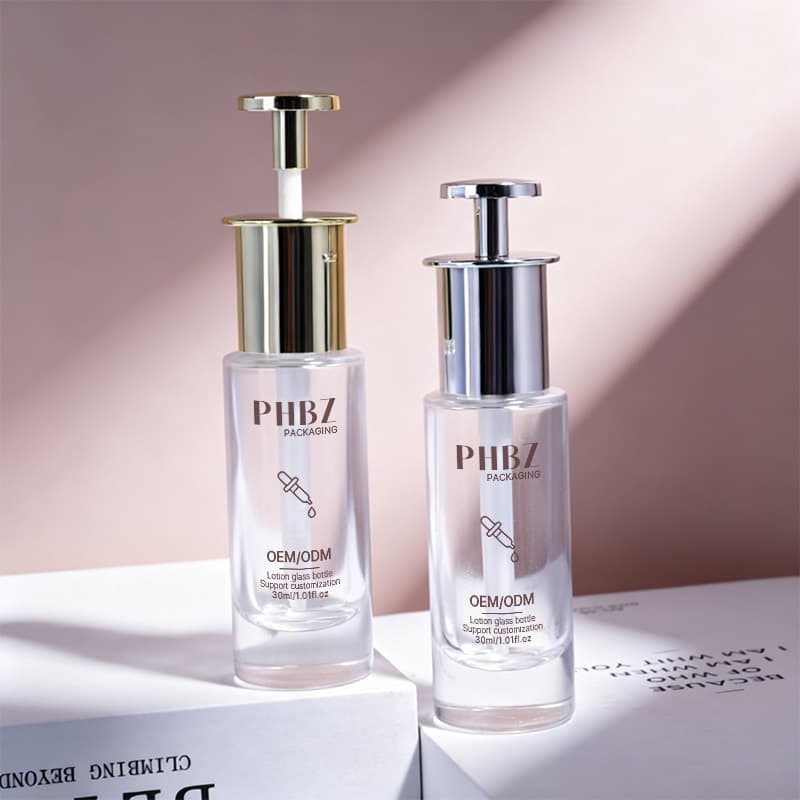
We get asked one question more than any other by brand owners and procurement teams: "Should I spec extra-clear glass or standard clear glass for this bottle?"
At PengHuang, the answer is fixed. We manufacture cosmetic glass bottles in extra-clear glass only. Not because standard clear does not exist, but because for cosmetic packaging the glass is the first thing a customer sees, and the difference is exactly what they notice. Below is the full reasoning, how to check you are actually getting extra-clear, and how to design around it so the glass works for your brand.
What actually separates them (and it is not "whiteness")
The names mislead. The real difference is iron content.
Standard clear glass (the regular soda-lime type) carries more iron, roughly 0.1% to 0.3%. Iron acts as a colorant in glass, so when you hold a standard clear bottle up to the light, you will see a faint green or blue-green cast, most visible through thicker walls.
Extra-clear glass (also called ultra-clear, low-iron, or crystal glass) drives iron down close to zero, usually under 0.02%. Light transmits cleanly, and the bottle reads as bright and clear, close to crystal.
Both are soda-lime glass. The difference is purity and light transmission, not strength and not a safety grade. That last point is why we chose extra-clear as our standard: for a premium cosmetic brand, the look is the product.
Side-by-side cosmetic serum bottles: extra-clear glass on the left, standard clear glass on the right showing a faint green tint through the wall
How to verify you are getting real extra-clear
Many suppliers quote "clear glass" and ship standard clear with a green tint. The buyer only finds out on the shelf. You do not need a lab to check:
This is exactly why we standardized on extra-clear: what you spec is what you get, with no green surprise at production.
Two empty glass bottles on a white background illustrating the iron-content difference between standard and extra-clear glass
Three mistakes we keep seeing brands make
1. Assuming every "clear glass" quote is the same.Some suppliers quote "clear glass" and deliver standard clear with a green cast. The gap shows up under retail lighting, on a transparent or light-colored formula, and it reads as "cheap" even when no one can name why. Backlight the bottle before you approve the sample. This is the single easiest way to protect your shelf look.
2. Using standard clear for a clear bottle.If your product is a clear serum, a brightening toner, or any light-colored formula that needs to show through, the green cast of standard clear drags the whole package down. For these formulas, extra-clear is not a nice-to-have, it is the baseline.
3. Assuming extra-clear is stronger or safer.This is the big one. Extra-clear and standard clear sit at about the same level for mechanical strength, thermal resistance, and chemical resistance. It does not get tougher just because it is clearer. On safety, what matters for cosmetic contact is heavy-metal migration, lead and cadmium, and that applies to both, under standards like FDA (US), EU (EC) 1935/2004 food-contact framework, or GB 4806.11 (China). Clarity does not change that, so do not pay a safety premium that does not exist.
Four things that change how much the clarity shows
Short version: extra-clear is what your customer notices before they read the label. We standardized on it so you never have to second-guess the glass.
Before you commit to tooling, and for export
Lock your glass spec and finish before tooling. Because we run extra-clear only, there is no risk of a sample-in-extra-clear, production-in-standard-clear mismatch. You should still confirm the finish, coating, frosting, or printing, before we cut the mold, so the whole pack lands as intended and there is no rework.
For EU- or US-bound bottles, customs and buyers check heavy-metal migration and lead or cadmium extraction, not the glass clarity. As long as the glass meets FDA, EU (EC) 1935/2004, or GB 4806.11 contact standards, it ships. Extra-clear still has to clear those same limits, so do not relax compliance testing just because a bottle looks premium.
Frequently asked questions
Is extra-clear glass safer than standard clear for cosmetics?No. Cosmetic contact safety comes down to heavy-metal migration, lead and cadmium, under standards like FDA, EU (EC) 1935/2004, or GB 4806.11. Both glass types must meet the same limits. Clarity does not change that.
Do I need extra-clear if my bottle is frosted?Frosting shrinks the visible gap, so it matters less for a fully frosted bottle. We still run extra-clear across the board so your range stays consistent and the base under the frost stays clean. One glass spec means fewer variables to manage.
Why does extra-clear glass cost more?It uses low-iron raw material and tighter process control to keep iron near zero. The premium only pays off where the clarity is actually visible, such as clear, uncoated bottles, which is exactly where a cosmetic brand lives.
Talk to us about your bottle
We are PengHuang, a direct manufacturer of cosmetic glass bottles, and extra-clear is all we run, by design. We keep extra-clear in stock and handle custom-tooled orders. Our glass bottles are finished in-house, frosting, coating, and metallization, so material and process are planned together.
If you want to see the difference side by side, or you have a sample you would like us to match or develop a custom mold for, reach out. We will help you get the most from extra-clear instead of leaving it to guesswork.