
Glass Bottles vs. Plastic Parts in Rubber Spray Coating: Process and Cost Comparisons
Published
In our years of manufacturing cosmetics packaging, rubber paint (also known as soft-touch paint) is one of the surface treatments most frequently asked about by clients. Many brands and traders assume that rubber paint for glass bottles and plastic parts are two different things, and that the price difference is due to different technologies. That is not the case. The underlying substance is the same for both; the only difference is the sequence of one process step, and the cost implications of that sequence. Below, we break down the actual practices in our factory.
I. What is rubber paint?
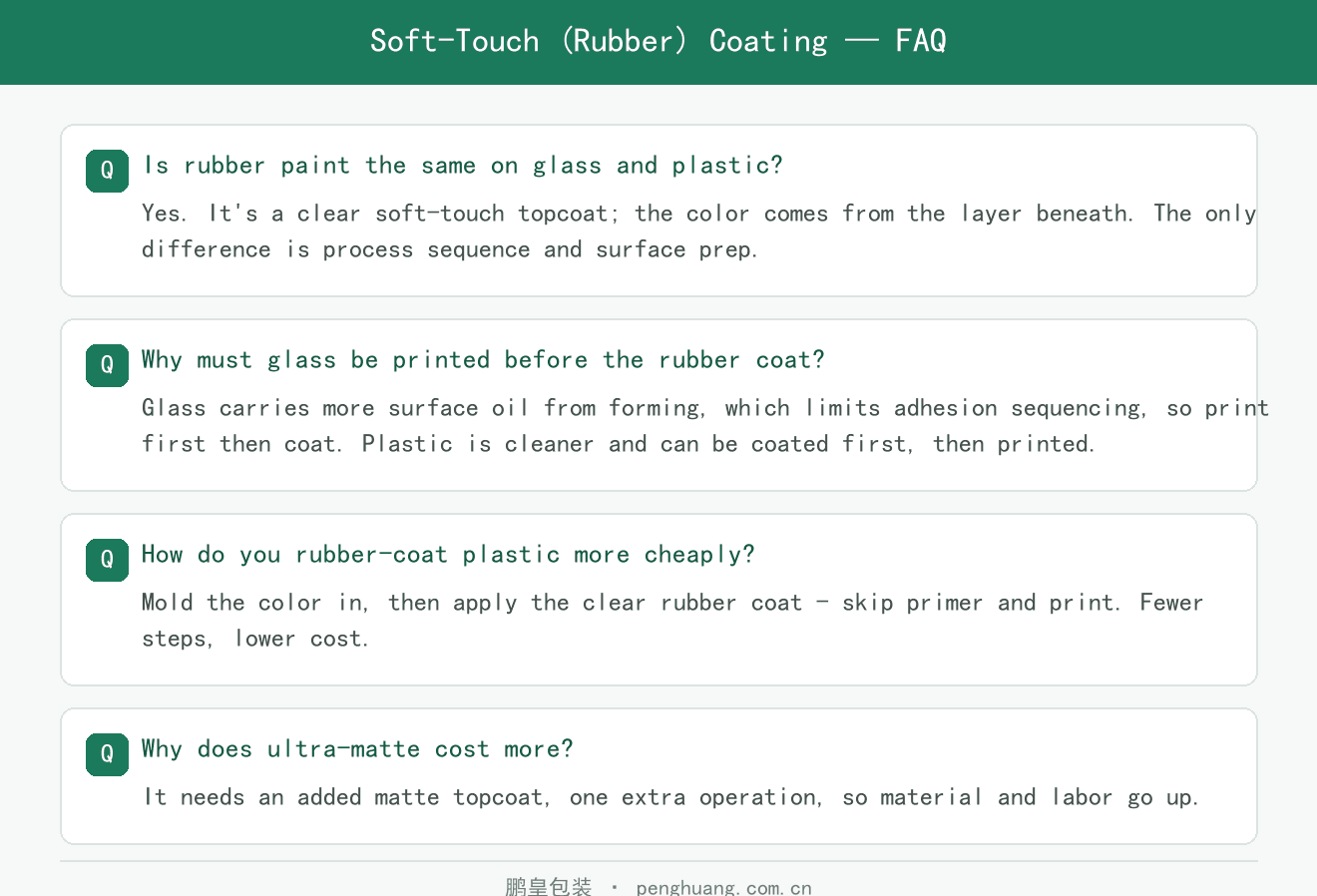
Rubber paint is a transparent soft-touch coating applied as the outermost layer. It feels like rubber to the touch, with a matte, non-reflective finish. Because it is transparent, the color you see is not provided by it, but by the underlying base color or print. It handles only two things: hand feel and matte degree.
II. Glass bottles vs. plastic parts: Same principle, different sequence
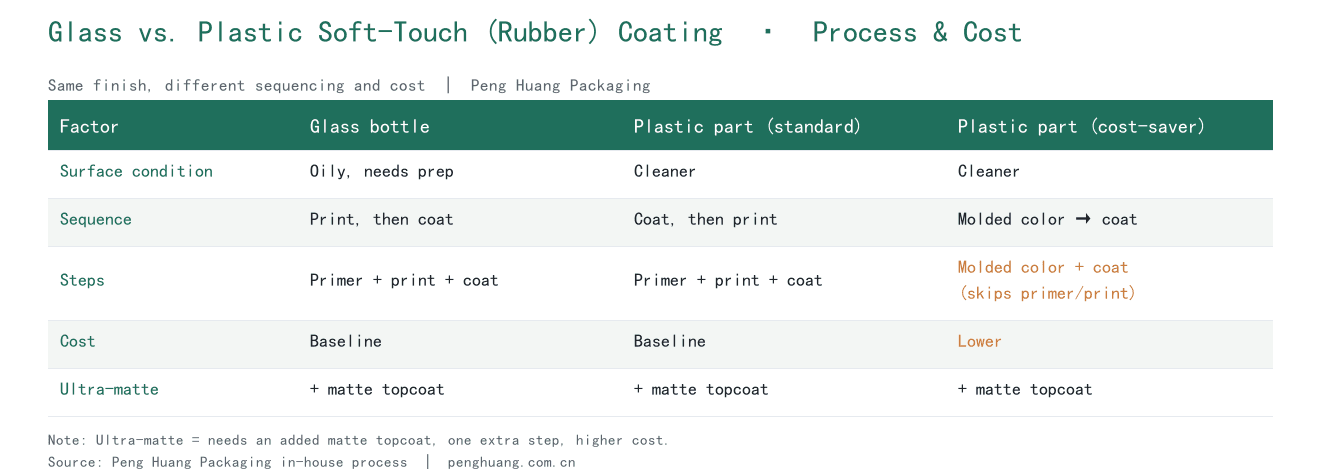
The principle is completely identical. The real difference lies in the surface state.
Do not underestimate this step. Because the sequence is fixed, printing is basically unavoidable for glass bottles, while plastic parts have flexibility.
III. General practice: Primer + Printing + Rubber paint
For both glass and plastic, the general factory practice uses three layers: a primer to enhance adhesion, silk-screen printing or pad printing for patterns, and finally a transparent rubber paint to finish. Most glass bottles follow this route; plastic parts can too, but they have a more cost-effective path.
IV. Cost-saving approach for plastic parts: Injection molding base color + Rubber paint
For plastic parts, the color can be injected during molding, followed by a transparent rubber paint layer, eliminating the two steps of primer and printing. Since the rubber paint is transparent, the injected base color naturally shows through, providing both color and hand feel. This reduces process steps and lowers costs. For the same hand feel effect, plastic parts generally offer a better price than glass bottles, and this is the reason why.
V. Special case: Extra matte requires matte paint
Rubber paint itself is already matte enough. However, if clients want a matte finish even more so, an additional layer of matte paint is required to maximize the matte effect. This adds an extra process step, increasing material and labor costs. Therefore, extra-matte requirements must be quoted separately and not mixed with standard items.
VI. Process and cost comparison
VII. How Penghuang chooses the process
We are a source factory for cosmetics packaging. We in-house mold development for glass bottles, with most items in stock, and handle the full chain for plastic parts and accessories. When encountering rubber paint requests, we first ask three things: the desired color, the desired hand feel and matte degree, and the budget and minimum order quantity. Then we decide whether to follow the standard three-layer route or the cost-saving injection base color + rubber paint route. Extra-matte is quoted separately; we do not keep clients in the dark with vague accounts.
The cost of rubber paint is not mystical. Clearly define the color and matte degree, and the logic of the sequence, whether to add matte paint, and the costs will be clear.For sampling or quotation, contact Penghuang Packaging. Provide your color and hand feel requirements, and we will propose a solution. Official website: